
In a project of Customer Data Platform, Often, we talk about collection, unification, segmentation, scoring, or marketing activation. And that’s normal: these are the most visible dimensions for marketing teams.
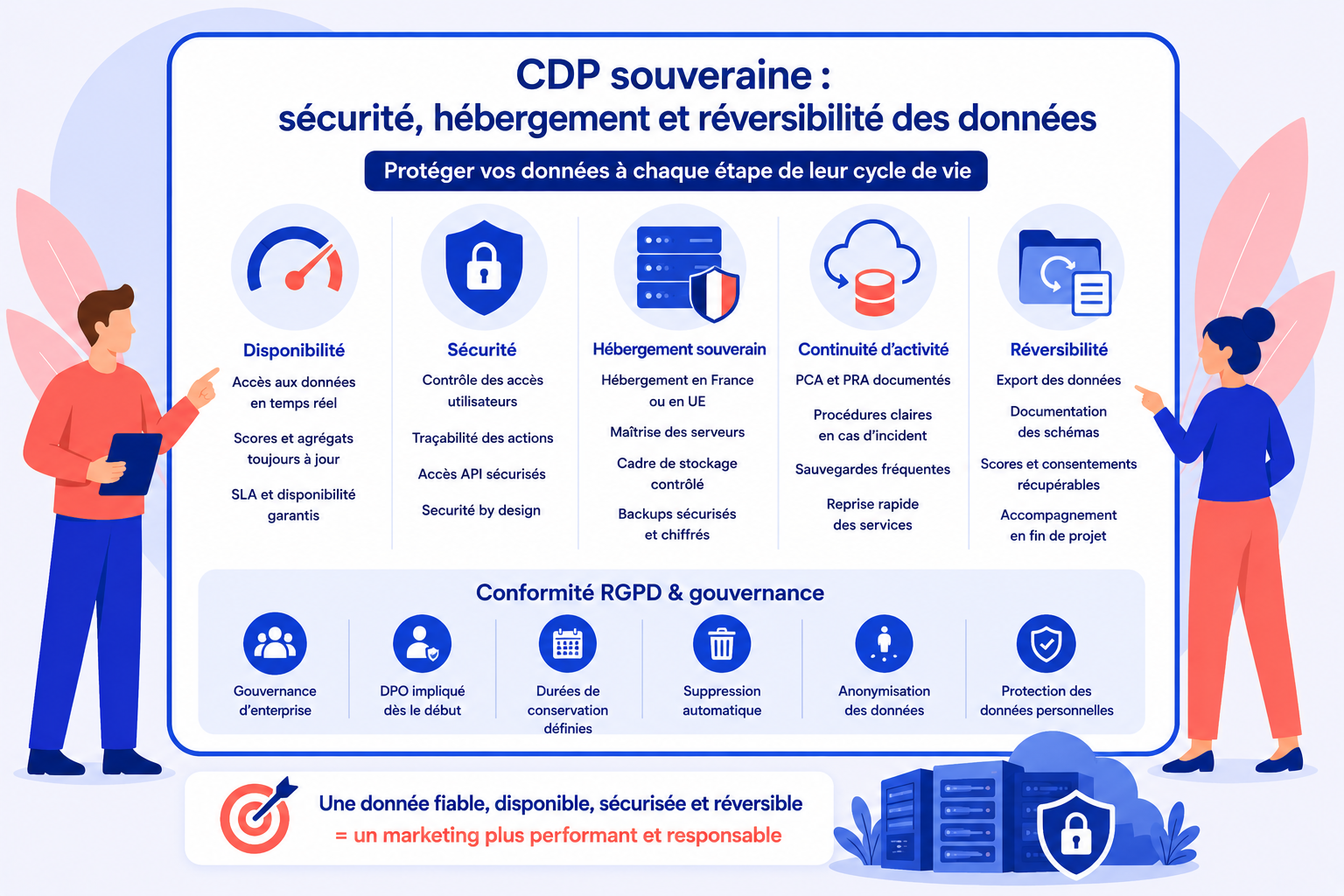
But a successful CDP project is not only based on the ability to exploit data; it also relies on the ability to protect it, to make it available, to ensure its hosting in a controlled environment, and to plan for what will happen if the organization changes its solution or provider.
In other words: a customer data is only valuable if it is reliable, accessible, secure and that you remain the true owner of it!
This is particularly true when the end users who are responsible for marketing, CRM or digital initiatives do not necessarily have control over the more technical aspects of the project that fall under the responsibility of the IT department.
In this fifth advice from our saga on how to successfully implement a sovereign Customer Data Platform, we return to a point that is sometimes underestimated when choosing a CDP: complete control over the data Data life cycle.
The importance of data management
When choosing a CDP, it is not enough to check that it knows how to collect data, create segments or triggering personalized campaigns.
It is also necessary to ensure that the platform is able to answer several essential questions:
- Where are the data stored?
- Who can access it?
- How are the access points plotted?
- Is the data available in real time?
- What happens in the event of an incident?
- Is there a continuity or business recovery plan in place?
- How are backups managed?
- How to recover all the data at the end of the contract?
- Are the protocols, scores, consents, and treatments documented?
These questions may seem technical. Yet, they have a direct impact on marketing performance.
If data is not available at the right time, an automation scenario may not trigger. If a score is not calculated in time, personalization may become less relevant. If consents are not properly recorded, compliance becomes difficult to demonstrate. If exports are not managed properly, the risk of leakage or unauthorized use increases.
Managing data through a CDP is therefore not only a part of the job; it is also an IT or legal issue.
Why is this topic becoming central in CDP projects?
Customer data has become a strategic asset for companies. It allows them to better understand customer journeys, personalize messages, optimize campaigns, retain customers, and improve business performance.
But the more central a data becomes, the more it must be regulated.
A CDP consolidates data from many points of contact: the website, mobile app, forms, email campaigns, SMS, notifications, CRM, ERP, business tools, or API connectors. It is gradually becoming the focal point of the business ecosystem.
It is precisely for this reason that its level of security, availability and Governance must be studied from the outset.
A data marketing platform should not only allow you to go fast; it should also allow you to go fast within a controlled framework.
This involves thinking about security from the very beginning of the project, not after the fact. This is often referred to as a “by design” approach: access rights, retention periods, deletion rules, anonymization, traceability, and documentation must be integrated into the data model and into the business processes.
The availability of data: a criterion too often underestimated
In a CDP project, the availability of the data is essential.
Available data is not simply data stored somewhere; it is data accessible at the right time, by the right system, for the right use.
Some data must be able to be exploited almost in real time. This is the case, for example, when a customer event must trigger immediate communication, when a score must be recalculated quickly, or when operational information must be pushed to a activation channel.
Let’s take a simple example: if an airline has to notify a passenger about a change in the boarding gate, the data cannot arrive several hours later. It must be available immediately, reliable, and activated on always-on mobile channels such as mobile push notifications.
Beyond the notion of refresh time for an available data item, another concept is equally essential: the ability to access the data.
A behavioral data, a consent, a customer status or an intent signal can lose much of its value if its processing is too late. A time of unavailability of the data due, for example, to technical problems at CDP can have concrete consequences in terms of business.
That is why it is important to check with your provider the availability commitments associated with the platform. These commitments are usually formalized in an SLA, or Service Level Agreement.
The SLA It allows to frame the expected levels of service: availability of the infrastructure, response time, intervention deadlines, incident procedures, support commitments, etc.
For a marketing department, this document is not a contractual detail; it is an operational guarantee.
Data hosting: a question of sovereignty and trust
Data hosting is another key point whose importance has never been more clearly perceived than in these times of geopolitical turmoil.
In a context GDPR, With digital sovereignty and control over subcontracting chains, companies must know exactly where their data is stored, where it passes through, and who can technically access it.
It is not just a question of knowing whether the data are hosted “in the cloud”. It is necessary to understand in which country, under what contractual framework, with which subcontractors, and under what guarantees.
For some organizations, especially public actors, institutions, companies subject to strong regulatory requirements, or organizations handling sensitive data, this question is crucial.
Accommodation in France or in the European Union can meet compliance issues, but also requirements of sovereignty, control and trust.
At Smartprofile, this mastery of hosting is part of the fundamentals. The platform allows hosting data on servers managed in France or Europe, with the ability to meet specific requirements, including strictly national hosting when the client context requires it.
This approach is particularly important when working with customer data, whether administered, allocated, or used by users. In these cases, the question is not just “where are the data stored?”. It is also “what path do they follow between collection, processing, activation, and backup?”.
Because sovereignty does not stop at the main hosting service. It concerns the entire lifecycle of the data.
Securing access and tracking usage
The security of a CDP also involves access control.
- Who can access the data?
- Who can change them?
- Who can export them?
- Which application can access which data via API?
- Which users have access to segments, scores, or consents?
- Are the actions being recorded in history?
These questions are fundamental, because a vulnerability does not always stem from an infrastructure problem. It can also come from too wide an access, uncontrolled export, a bad configuration, or use that is not validated by IT.
In a context where marketing teams are increasingly using tools, connectors, and sometimes generative AI solutions, the risk of Shadow IT / Shadow AI Data can be copied, exported, or used in uncontrolled environments without validation by the DSI or the DPO.
Traceability then becomes indispensable.
A CDP should allow us to know who is doing what, when, and with what data. This level of control is essential to secure the operation of customer data, but also to demonstrate the compliance of processing in the event of an audit, an internal request, or an incident.
PCA, PRA and backups: anticipating incidents before they happen
No organization can afford to assume that incidents will never happen.
Major failure, cyberattack, human error, unavailability of a service, data corruption, access problem: the scenarios can be multiple.
That is why it is important to ensure that the provider has a PCA and a PRA.
- The PCA, or Plan of Business Continuity, aims to maintain an acceptable level of service in the event of an incident.
- The PRA, or Plan de Reprise d’Activité, aims to restart services under the best conditions after a major incident.
These documents must be clear, understandable, and adapted to the criticality of the data being processed. They must not be considered contractual annexes that are discovered too late.
One must also pay attention to backups.
- Where are they stored?
- How often are they performed?
- Are they quantified?
- Are they hosted in the same country as the main data?
- Are they tested regularly?
- How long are they kept for?
Again, these questions have practical implications. An uncontrolled backup can become a weak point in the security chain. Conversely, a clear and robust backup policy greatly contributes to the resilience of the device.
Reversibility: a question to ask before signing
Reversibility is often discussed at the end of the project. However, it is at the beginning that it must be planned.
When you use a CDP, you gradually build up a wealth of data and knowledge: unified profiles, historical data, segments, scores, consents, data models, management rules, scenarios, dashboards, exports, connectors.
If one day you decide to change your solution, to re-internalize part of the system or to evolve your architecture, you must be able to recover these elements in good condition.
Reversibility does not simply consist of exporting a contact base. It involves being able to transfer structured and exploitable knowledge.
It is therefore important to ask the right questions before entering into a contract:
- Will we have access to the documentation of the Data model ?
- Are the data patterns described?
- Are the calculation rules for the scores documented?
- Are consents and their evidence exportable?
- Can the interaction histories be restored?
- Are the export formats standard and usable?
- What are the arrangements for support at the end of the contract?
Good documentation serves the success of the project during its operation. But it also serves to avoid excessive dependence on a provider.
This is an essential point in a logic of sovereignty.
Who is affected?
This topic concerns all organizations that use or are considering using a CDP, an automation marketing platform, an analytics tool, or an omnichannel activation solution.
It particularly concerns:
- Marketing departments that want to better exploit their customer data
- CRM managers who drive campaigns, segments, and consents
- Digital directions that track paths and conversions
- The data teams that structure the models and the flows
- ISDs that guarantee security, architecture, and availability
- The DPOs who ensure compliance with the GDPR and the rights of individuals.
A CDP project is rarely a purely marketing project. It is a business project, involving several stakeholders.
Success therefore relies on shared governance between marketing, IT, data, legal, and compliance.
How to choose the right provider?
To evaluate a CDP or Data Marketing solution, it is useful to go beyond the functional demonstration.
The visible features are important: segmentation, scoring, campaigns, dashboards, connectors, personalization, and marketing automation.
But the criteria of trust are equally essential.
Here are the main points to check:
1. The location of the accommodation
Make sure you know where the main data, backups, and associated technical environments are located.
2. Commitments of availability
Ask about the SLAs associated with the platform, the guaranteed levels of availability, and the procedures in place in case of an incident.
3. Security of access
Check the rights management, the traceability of actions, API access, authentication mechanisms, and logging capabilities.
4. GDPR governance
Make sure that retention periods, consents, deletions, anonymization, and the rights of individuals are well taken into account.
5. The PCA/PRA
Ask about the continuity and business recovery procedures, as well as the testing and updating procedures.
6. The safeguarding policy
Check the frequency, encryption, location, and retention period of the backups.
7. Reversibility
Ensure that the data, diagrams, scores, consents, and documentation can be retrieved in an exploitable format.
8. The accompaniment
A good provider should not only provide a tool. He or she should also help to frame the use of the tool, document the project, engage with stakeholders, and secure the structuring choices.
Things to remember
One Customer Data Platform It is not limited to a platform capable of collecting, unifying, and activating customer data.
For a project to be truly sustainable, it is also necessary to guarantee the availability, security, hosting, traceability, governance, and reversibility of the data.
These topics may seem technical, but they directly impact marketing performance, GDPR compliance, customer trust, and the company’s ability to maintain control over its data assets.
Before choosing a solution, therefore, ask the right questions: where will your data go, who will have access to it, how will it be protected, how will it be backed up, and how will you be able to retrieve it tomorrow?
At Smartprofile, we are convinced that a Customer Data Platform must enable organizations to fully exploit their customer data while maintaining control over their security, sovereignty, and complete lifecycle.
Do you want to discuss your sovereign CDP project or secure the exploitation of your marketing data? The Smartprofile teams can help you frame your usage, data governance, and activation initiatives.