
The situation within companies is often the same, regardless of their size: customer data is too often scattered across websites, mobile applications, CRM systems, email management tools, or forms management tools, as well as ERP business applications and internal files. Faced with this fragmentation, a Customer Data Platform It allows to centralize, unify, make reliable and active the customer data and thus to understand the customer or prospect journey, to segment the audiences in order to better activate them and to customize the marketing actions.
Once this fact is established, the question that follows is then: “Which tool to choose? ”
As we delve into this question, many related topics quickly emerge: the location of the data with a preference for hosting in France, data security and processing within a regulatory framework; the tool must be ergonomic for use by marketing and sales teams, but also be able to integrate with the IT system, have APIs, allow for micro-level reporting of actions, and also be able to manage the overall direction of the company.
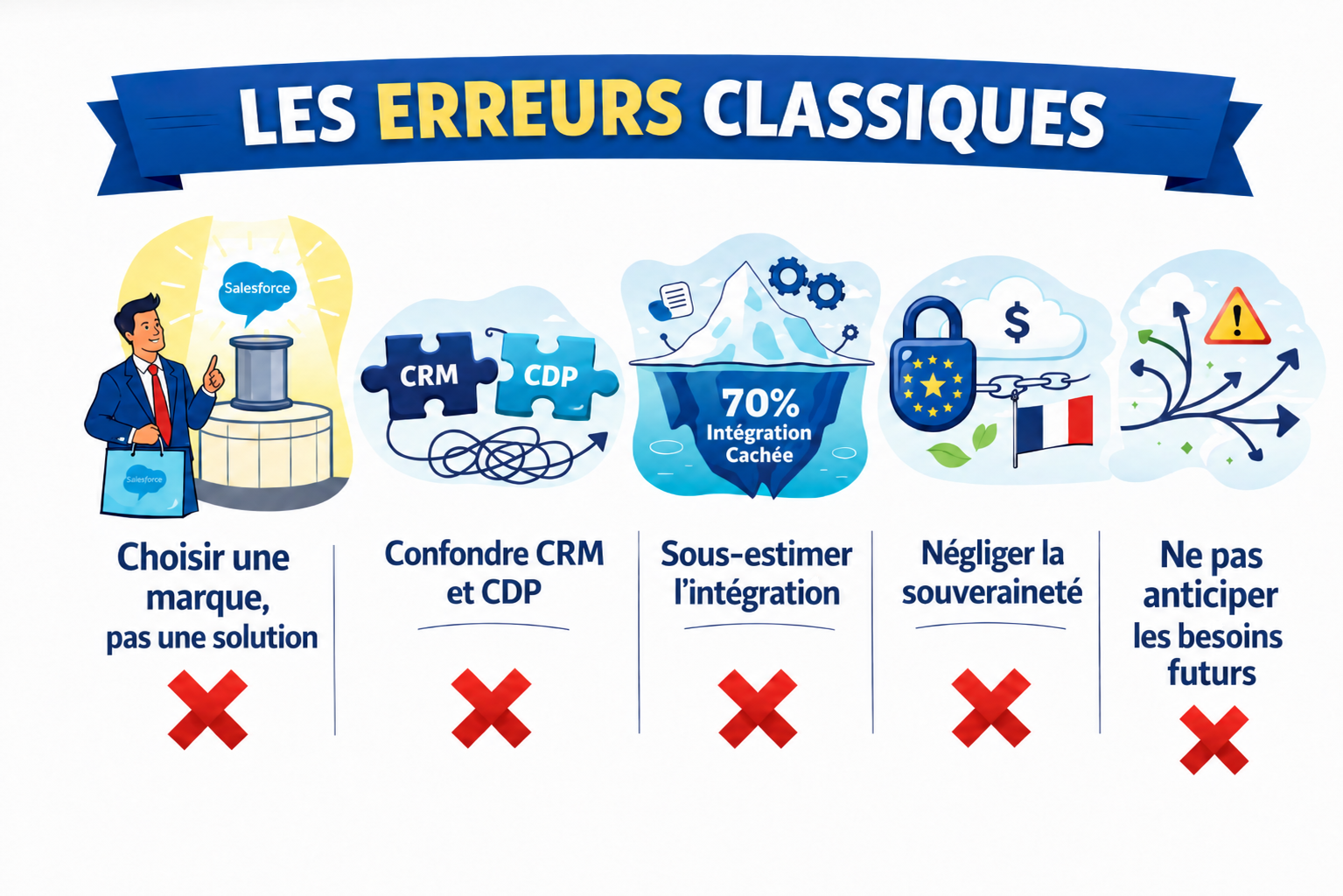
In the face of these questions raised very early in the project, the easy solution is often to use an AI tool like Chat GPT to ask colleagues and thus build up a list of solutions to the Prévert problem among the many available on the market. The risk is then to end up choosing the least controversial solution, or the most well-known one, which often contributes to the current hype.
But does this choice allow Really answer the question: on What specific business processes related to our activity, our organization and our objectives do we want to work on?
Car Before talking about the tool, it is necessary to clarify the expectations of the marketing, CRM, data, and digital teams, as well as those of the commercial, IT, and general management departments, because a Customer Data Platform is a means to serve a corporate strategy.
Why should we never start with the tool?
Not all tools meet the same needs in terms of usage, the way in which data is structured and activated, and sometimes the costs involved do not allow the project’s ROI to be achieved within reasonable timeframes.
A CDP, regardless of its capabilities, cannot compensate for a lack of initial planning: writing down the business processes, identifying the data sources, defining the must-have features as well as the nice-to-have ones, and identifying the actual users.
The risk then is to create a new platform… which adds to the existing silos without actually solving the problems.
And too often, the projects end up being misleading, with users who may have the impression of being faced with a “super Excel file” disguised as a strategic project.
This will not be the case if your project from the very start has been well thought out and we will see how, and how to finally enable a CDP to meet very specific needs such as:
- Better understanding of its customers and prospects;
- Reconciling online and offline data;
- Improving marketing segmentation ;
- Personalizing communications;
- Automate CRM scenarios ;
- Ensure the reliability of reporting;
- Managing consents and the GDPR rules ;
- Improving the performance of campaigns;
- Identifying high-potential customers;
- Reduce churn or reactivate dormant contacts.
We will see that it is necessary to verify that all these processes can be deployed on your company’s data, in your specific IT context and in relation to your resources.
The good starting point: business use cases
A use case is a concrete situation in which CDP will create value.
For example:
- Identify known web visitors in the CRM database;
- Send a recovery scenario after a request for documentation;
- Segmenting contacts based on their level of engagement;
- Detecting inactive customers for several months;
- Personalizing an email according to the content viewed;
- Centralize marketing consents;
- Creating a 360° view of the customer for CRM teams;
- Trigger an SMS or email campaign based on behavior;
- Produce a consolidated dashboard on marketing performance.
These use cases allow us to move from an abstract logic — “we want a CDP” — to an operational logic — “we want to improve the qualification of our leads, reactivate our inactive customers, and better manage our omnichannel campaigns”.
It’s much more concrete for the teams. And above all, it’s much easier to measure.
A good use case must answer a few simple questions:
- What business problem do we want to solve?
- Which teams are affected?
- What data are needed?
- Where are they today?
- Which channel will be activated?
- Which indicator will measure success?
- What GDPR constraints must be taken into account?
This step may seem obvious. Yet it is often underestimated and is what determines the success of the project.
A CDP project is also an internal alignment project
A CDP must not involve only one team.
To be effective and virtuous, the implementation of a CDP and its daily use must involve several stakeholders: marketing, CRM, digital, IT, customer service, legal…
Everyone has their own priorities.
- The marketing department wants to target its campaigns more specifically.
- The DSI wants to ensure the security, interoperability and technical robustness.
- The DPO wants to ensure that the processing is compliant.
- CRM teams want to have reliable and exploitable data.
- The general management wants to measure the impact on performance.
The initial framework allows defining a common language, prioritizing expectations, and avoiding misunderstandings. The project to establish the CDP must involve all stakeholders from the initial phase of needs assessment, thus enabling the various stakeholders involved to collaborate more optimally.
In this sense, it is a strategic project for the company and our recommendation is to create a cross-functional team involving employees from within each involved department.
The Smartprofile approach: starting from the profession to make the data actionable
At Smartprofile, we believe that a CDP should primarily serve the needs of the business teams.
The Smartprofile platform allows collecting, unifying, processing, analyzing and activating customer data within a secure environment, compliant with GDPR and designed for marketing, digital and CRM departments.
But technology alone is not enough.
Success also depends on the support, understanding of business issues, the quality of the framework and the ability to turning data into concrete actions.
That’s why the approach must be gradual: starting with objectives, identifying the data that is truly useful, building reliable customer profiles, and then activating the right messages on the right channels.
A CDP should enable us to do better, not just to do more.
- Better understanding of its audiences.
- Better segmenting its campaigns.
- Better manage your performance.
- Better to respect preferences and consent.
- Better customize interactions.
- Better transform the data into marketing decisions.
And what's more, CDP Smartprofile is sovereign: designed, developed and hosted in France, for more than 20 years.
Things to remember
A CDP is a Powerful leverage To regain control of its marketing data, improve customer knowledge and activate more relevant campaigns. But to create value, it must be conceived as a business project, involving data and organizational aspects.
The #1 advice is therefore simple: Before choosing your CDP, define what you want to achieve with your data.
Do you want to frame your CDP project with a business-driven approach that complies with the GDPR? The Smartprofile teams can help you define your use cases, structure your data, and activate it for marketing purposes.