
As we have seen in our previous articles, identifying the need, collect, centralize and unify customer data They are the essential first steps in any project of implementation of a Customer Data Platform. But once this data is structured, validated and augmented, a question quickly arises: What is being done concretely?
This is precisely where the value of a CDP lies: turning Data into a real business lever.
A consolidated customer base, however rich it may be, is not enough to improve the customer experience or marketing performance. To bring value, data must be activated: in campaigns, journeys, CRM scenarios, dashboards, and decision-making processes.
In other words, a CDP should not only allow you to better know your customers; it should help your marketing teams take action in the simplest, fastest, and smartest way possible.
Why is activation a key step in a CDP project?
In many organizations, customer data already exists; it is often scattered throughout the IT infrastructure in CRM systems, Excel files, business tools, the database of a website or mobile application, or cash register software, …
The problem is therefore not always the lack of data. The real issue is rather the ability for business teams to simply use the information made available in the CDP at the right time to take concrete action.
As we saw in our previous article, a CDP allows us to transform scattered data into a single, coherent picture. exploitable customer knowledge within a single client reference framework that makes reference to it. But this knowledge only takes on its full meaning when it feeds into concrete actions:
- Targeting the right contacts
- Personalizing messages
- Triggering marketing automation scenarios
- Choosing the most relevant channel
- Managing the commercial pressure
- Measuring the contribution of campaigns to business
- Identifying weak signals
- Anticipate certain customer behaviors
The challenge therefore is not to generate ever more data, but rather to put the right information to work for the business, customer experience, marketing performance, customer service, or sales teams.
Activating the data by orchestrating marketing scenarios
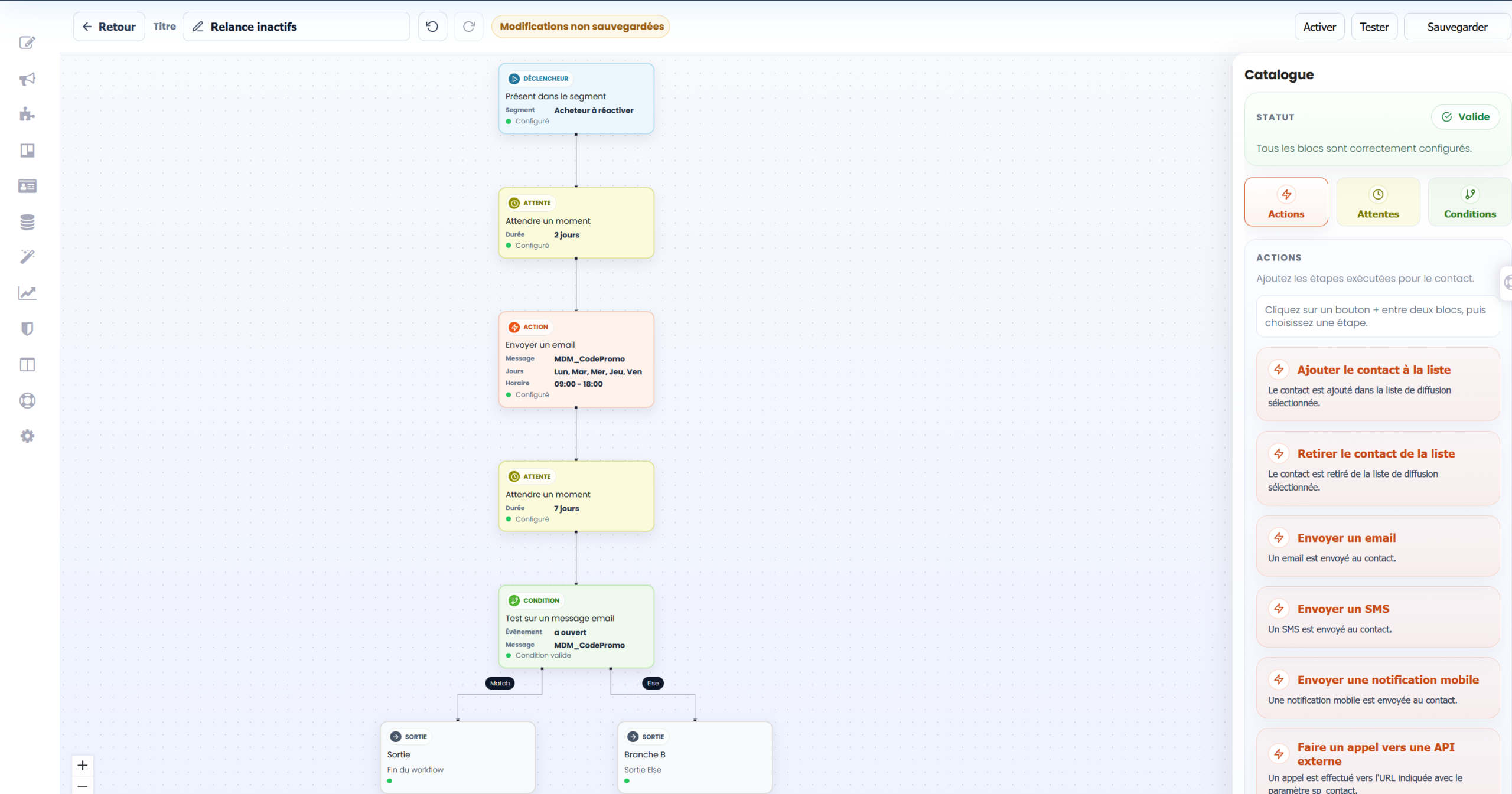
Once the profiles are unified and the segments created, the CDP must enable the triggering of relevant marketing scenarios. That is why the integration between CDP and marketing automation is so important.
In an ideal world, the CDP would not operate alongside the marketing orchestration tool. It should be directly connected to the relational scenarios and therefore natively embed a activation module as allowed by a Saas platform made in France like Smartprofile
It is this interconnection that allows us to answer very concrete questions:
- What message to send?
- At what time?
- On which channel?
- With whom?
- With what level of customization?
- Based on what behavior, score, or profile?
- With what commercial pressure rule?
For example, a highly engaged contact does not necessarily receive the same message as a cold lead. A loyal customer should not be treated like a new visitor. A user in a mobility situation will not have the same expectations as an internet user who calmly views content on their computer.
Activating the data allows us to take this context into account, and this is where the interaction between the CDP, which manages the context of the contact, and the marketing automation, which manages the activation through the sending of automated messages, takes on full meaning.
The right message, at the right time, on the right channel
One of the main contributions of a CDP is its ability to help marketing teams better manage “momentum”. In other words: identifying the right moment to interact with a contact.
This good moment may depend on several factors:
- the recent behavior of the contact
- its navigation history
- his level of commitment
- his liking score
- his/her client or prospect status
- its position in the life cycle
And to be most effective, the CDP will need to be able to choose the optimal channel in addition to the momentum, which may also depend on:
- calculated communication preferences for contact
- of Consent forms collected or not
- the channel that best suits the situation
In some cases, email will be the right channel; in others, choosing a channel more suited to mobility, such as SMS, a mobile notification, a web push, RCS, or a pop-in, will seem more appropriate.
This is especially the case when the information needs to be transmitted in real time. An email can be adapted for a newsletter, a commercial follow-up or a content recommendation. However, for urgent or contextual information, a mobile channel may be more effective.
The case of players in the tourism sector illustrates this logic well: depending on the stage of the user journey (the preparation of the trip, transportation, arrival of the traveler, etc.), the right channel and the right timing are not the same. The goal always remains the same: to streamline the experience by sending the useful information at the moment it is actually expected.
Personalize without over-demanding
Activating the data does not mean multiplying the messages. In fact, it is often the opposite.
Effective activation must enable better targeting, personalization, and dosage of solicitations. This is an essential point for marketing and CRM managers: a poorly managed marketing automation strategy can quickly create a Excessive commercial pressure.
If teams do not have a comprehensive overview of the messages already sent to a contact, it becomes difficult to know whether they are being overloaded. However, this pressure can harm the customer experience, engagement, and performance of campaigns.
CDP plays a central role here. It enables the consolidation of historical interactions, a better understanding of preferences, and more consistent management of communications.
The goal is therefore not simply to send more automated messages. The goal is to send more useful, more contextualized, and more respectful messages regarding the customer relationship.
Transforming CDP into a business lever
A CDP should not be perceived solely as a technical tool or as an improved database. It must become a real levering business.
To do this, it is essential to measure the contribution of the marketing actions implemented. What scenarios actually generate value? What paths need to be improved? Which segments react best? Which channels are most effective? What messages need to be tested, adjusted, or removed?
This logic of test and learn is essential.
Marketing teams must be able to analyze results, compare performance, and evolve scenarios over time. Some automated workflows will be very beneficial. Others will need to be reviewed. Some segments will require a dedicated approach. Others may be grouped or enriched.
The activation of the data must therefore always be linked to performance indicators: conversion rate, repeat purchases, engagement, customer value, reactivation, churn, contribution to revenue, or channel performance.
Actionable insights to better manage
Activation is not limited to marketing campaigns. A CDP must also allow for better management of the business.
By centralizing and extracting the data, it can feed customized dashboards directly into the platform or into business intelligence tools already used by the company.
The goal is to enable marketing, CRM, digital, or general management teams to have reliable and actionable indicators:
- performance of campaigns
- evolution of the segments
- Life Time Value
- conversion rate
- re-purchase
- source of contacts
- recurring behaviors
- signs of commitment or disengagement
The CDP should also allow for the answer to specific questions. For example: who are our new customers? What are their interests? Which segments are growing the most? What behaviors indicate an intention to buy or a risk of leaving?
This ability to produce business insights on demand is valuable. It avoids the need to stick to a few standard reports and gives teams more autonomy.
Anticipate and predict thanks to data
Once the data is validated and activated, it becomes possible to go further with scoring, clustering, recommendation, or prediction approaches.
The goal is not to replace marketing expertise, but to enrich it. Algorithms can help detect weak signals, identify high-potential profiles, spot atypical behaviors, or anticipate certain developments.
For a marketing department, this can translate into very concrete use cases:
- identify the customers most likely to repurchase
- detecting contacts at risk of inactivity
- recommend an appropriate offer or content
- prioritize certain segments
- adapt the scenarios according to the level of commitment
- improve the relevance of automated paths
Again, the data is only valuable if it serves a decision or an action, and in an ideal world with the ability to measure the repercussions of that action!
Don't forget about consents and preferences
Effective activation must also be a controlled activation, both in terms of marketing and legal matters.
Communication preferences and consent must be taken into account in the scenarios. This point is essential to comply with the GDPR framework, but also to build a healthier relationship with customers and prospects.
It’s not just about knowing whether a contact can be contacted; it’s also about understanding how they prefer to be contacted.
Does he/she prefer to receive emails? SMS messages? Mobile notifications? Does he/she want to be informed only about certain topics? How often? About what types of offers or services?
A good CDP should help teams integrate these rules into marketing activation. This allows for a balance between performance, personalization, and user choice respect.
Things to remember
The value of a CDP does not stop at collecting or unifying customer data. Its true value appears when it enables these data to be used in campaigns, scenarios, dashboards, and marketing decisions.
Activating data means being able to target the right contacts, customize messages, choose the right channel, respect preferences, manage sales pressure, and measure the real contribution to the business.
A well-thought-out CDP must therefore become a lever of action: to better engage customers, better manage performance and make marketing teams more autonomous.
Do you want to transform your customer data into concrete, measurable marketing scenarios that comply with the GDPR? The Smartprofile teams can help you structure, activate, and manage your marketing data.
The Smartprofile approach: making the data truly exploitable
At Smartprofile, we believe that a CDP should allow marketing, CRM, and digital teams to leverage their data without excessive dependence on third parties.
Once the project is well-defined, governance is established, and legal and IT rules are clarified, business teams must be able to use the data simply: create segments, drive scenarios, analyze results, generate insights, and adjust their actions.
The Smartprofile platform precisely integrates a Customer Data Platform, Web & Mobile Analytics modules, marketing automation, cross-channel activation capabilities, dashboards, and AI algorithms oriented towards responsible marketing.
The goal is simple: help companies move from raw data to useful marketing action.