
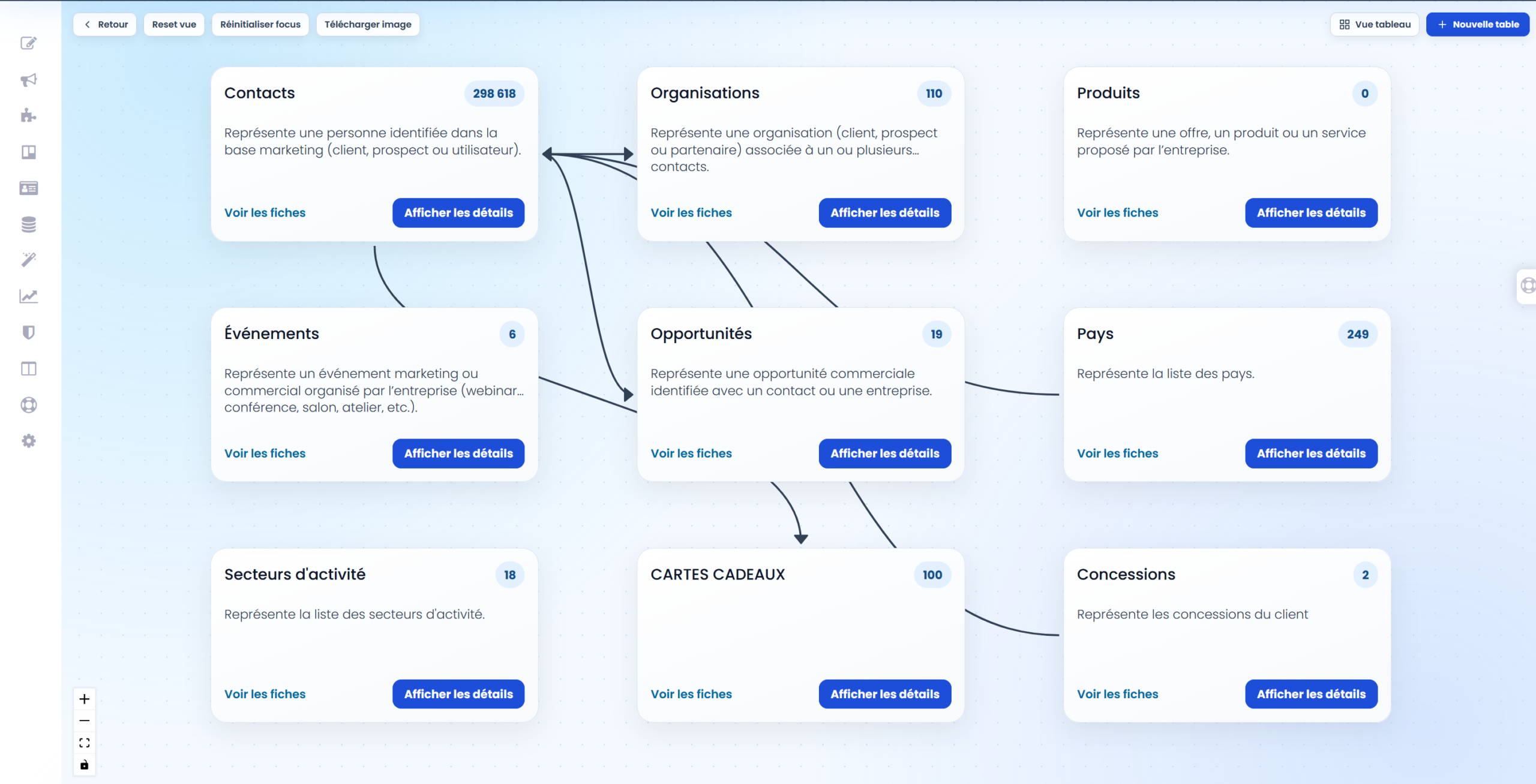
When a company implements a Customer Data Platform (CDP), a step is often decisive for the success of the project: the construction of the data model.
This model allows defining which customer data will be collected, how they will be structured, from where they will be synchronized, how often they will be updated, and how they can then be activated by the Marketing, CRM, or Sales teams.
This could, for example, be data from:
- From CRM
- From an ERP
- From the product catalog
- Transactions
- Forms
- Email, SMS or push campaigns
- Web and mobile paths
- Business applications
- Tools for marketing automation
At first glance, the subject may seem very technical, and the trap would be for the CDP data model to involve only the IT teams.
Why? Because a CDP only has value if it answers to certain Business use cases Concrete: personalizing a campaign, creating a segment, measuring a journey, triggering a follow-up, scoring a lead, analyzing a conversion, or improving customer loyalty.
While the CDP can be considered a tool serving the customer knowledge, the data model is what enables this tool to meet the business needs of the company.
Why is the data model a key step in a CDP project?
A CDP project is not simply about connecting multiple data sources together. It is about transforming often scattered, heterogeneous, and sometimes incomplete data into a reliable database that can be exploited with prepared and actionable data.
Without a clear data model, there are many risks:
- Collecting too much data without a specific purpose
- Forging forgotten essential data for marketing teams
- Creating duplications or inconsistencies
- Using the wrong reference source
- The need to resume flows after the launch
- Slow down the use of CRM systems or Marketing automation
- Degrading the quality of customer knowledge
In some projects, modeling is approached as a purely technical subject. IT teams define the tables, fields, flows, and data feed rules without having sufficiently integrated the end-user use cases.
The result: the business teams discover too late that some data is not available, not fresh enough or not structured in the right way, and CDP will therefore ultimately not be able to fully meet their needs.
Conversely, when the business teams are involved from the outset, the project gains in efficiency. The needs are clearly expressed, the priorities are established, and the technical choices are directly linked to the organization’s objectives.
Who should participate in the construction of the CDP data model?
The construction of a CDP data model requires the involvement of several experts.
- The Marketing and CRM teams bring knowledge of campaigns, segments, customer journeys, relationship programs, and activation needs.
- Digital and e-commerce teams know the web and mobile touchpoints, forms, conversion tunnels, events to follow, and useful behavioral data.
- IT teams identify the source systems, technical constraints, connectors, formats, APIs, batch processes, and security rules.
- Data or BI teams contribute to the quality of the data, In terms of structuring, consolidation, treatments and management indicators.
- Compliance or DPO teams can also intervene to validate the purposes, retention periods, consent rules and data minimization principles.
The goal is not to organize endless meetings with all the departments. It’s rather about bringing together the right people at the right time to ensure that the data collected meets the expected usage. Our recommendation: Establish a cross-functional team that is responsible for everything throughout the project.
CDP data model: what questions should be asked?
Before connecting the tools and powering the CDP, several questions must be asked.
A CDP project should begin with a simple question: what data do we really need to achieve our marketing, CRM, or business goals?
Indeed, not all available data is necessarily useful, and one of the project’s complexities will be to retain only the essential data to meet the needs and objectives set in advance, neither more nor less!
For example, data may be essential for a loyalty program, but unnecessary for a reactivation campaign. Transactional information may be critical for scoring purposes, but secondary for an editorial newsletter.
This logic is also essential in a GDPR perspective. The collection must remain proportionate to the goals pursued. Therefore, it is not a matter of storing everything “just in case”, but of selecting the relevant, necessary, and exploitable data.
For what uses will this data be used?
A good CDP data model always starts from usage:
- Is it desired? Better segmenting the customers?
- Triggering marketing automation scenarios?
- Identifying customers at risk of churn?
- Personalizing content?
- Propose a product recommendation engine?
- Measuring the performance of campaigns?
- Improving customer knowledge?
Each use case involves different needs.
For example, for a basket abandonment scenario, navigation and basket data must be available quickly. For a monthly loyalty analysis, updated transactional data at J+1 may be sufficient.
The right data model is therefore not necessarily the most complete one. It is the one that allows for effective responses to priority use cases.
What is the reference source for each data item?
The same data can exist in several systems.
A customer's email address can be present in the CRM, in the email tool, in the customer area, in the ERP or in a support tool. But that does not mean that all these sources have the same level of reliability.
It is therefore essential to identify the master system for each data set. Again, you can use an evaluation grid by asking yourself the following (non-exhaustive) questions:
- Which application has the most reliable version?
- Where is the data updated?
- Which tool is authoritative in case of a difference between two sources?
This step helps to avoid inconsistencies, duplications, and gaps between the various marketing and business tools.
CDP data flow: real-time, batch, or delayed update?
Once the model is defined, the data flows must be organized.
Not all data needs to be updated at the same frequency.
Some so-called “hot” data must be available very quickly. This is the case, for example, of a visit to a site, a product search, a cart abandonment, a click, or an interaction with a campaign.
Other data can be integrated in a delayed manner. Orders, invoices, or certain transactional histories can sometimes be imported at J+1 without impacting business practices.
This choice has a direct impact on the cost, complexity, and robustness of the device. In some cases, a real-time connector or API will be necessary. In others, batch file exchange will be simpler, more economical, and perfectly suited.
The good approach therefore consists of starting from the business need, and then choosing the most appropriate mode of supply.
Why integrate web analytics and mobile analytics data into the CDP?
Analytics data is often underutilized in CDP projects.
They sometimes remain isolated within a tool of Web Analytics, Without being reconciled with CRM, transactional or marketing data. However, these behavioral data are valuable for enriching customer knowledge.
They allow us to better understand:
- The pages visited
- The products you are looking for
- Content that generates interest
- The paths before conversion
- The points of escape (abandon) in the course
- The signals of intention
- Usage on mobile or app
This information is particularly useful for creating segments, personalizing messages, prioritizing follow-ups, or feeding scoring and recommendation algorithms.
That is why the tagging plan must be considered from the very beginning of the CDP project.
This plan defines the events to be collected, the associated properties, naming rules, and the data that will enrich the customer profiles.
With a native module of Web & Mobile Analytics, Like the one integrated into Smartprofile, journey data can be collected and correlated directly with other customer data. The goal is to move from an isolated measure of visits to a consolidated view of the customer journey.
First-party and zero-party data: a key lever for customer knowledge
In a context of increased data control, first-party and zero-party data become particularly strategic.
First-party data is the data collected directly by the company at its own points of contact: website, mobile app, customer portal, purchase history, CRM interactions, or marketing campaigns.
Zero-party data is the data that the customer voluntarily shares: preferences, intentions, responses to a form, declared choices, interests, or future projects.
This data is valuable because it allows for the creation of more reliable and actionable customer knowledge.
It is also necessary to properly integrate them into the CDP data model.
A declared preference in a form, a search performed on a website, or behavior observed in an application can become very useful signals for customizing a campaign or anticipating a need.
Provided, of course, that these data are structured, historicalized, linked to the right profile, and usable by the marketing teams.
How can the quality of the data be ensured over time?
The implementation of the flows does not mark the end of the project. In fact, it is often at this point that the real piloting work begins.
A CDP must be fed with reliable, regular and consistent data. To do this, it is essential to track the flows over time.
It is necessary to be able to detect an error, identify a flow disruption, correct a badly formatted data entry, replay an import, or alert the appropriate contact in case of a problem.
Without supervision, a customer base can quickly lose in quality. And a CDP powered by incomplete or outdated data becomes difficult to exploit for business teams.
The quality of the data is therefore not an occasional issue. It is a continuous discipline, based on clear rules, controls, alerts, and shared governance.
Things to remember
The data model is one of the pillars of a successful CDP project.
It allows you to define which data to collect, how to structure it, which sources to use, which flows to implement, and how to make the data usable by the marketing, CRM, and digital teams.
To be effective, this step must not be reserved for technical profiles only. It must involve the professions, IT, data, and compliance around priority use cases.
It is this collaboration that allows us to avoid costly duplications, limit over-collection, ensure data reliability, and build a truly operational Customer Data Platform.
In short: before personalizing, you need to structure things. Before activating, you need to ensure reliability. And before deploying a CDP, you need to ensure that the business and IT teams share the same data language.
Do you want to structure your marketing data model or ensure the reliability of your customer flows? Smartprofile supports companies in setting up a sovereign Marketing Data Hub, combining CDP, Web & Mobile Analytics, AI and marketing automation.