
Establishing a Customer Data Platform It does not consist solely of collecting and centralizing customer data in a single tool. This is an essential first step, but it is not enough.
Once the data has been collected and organized in the single customer repository, the cornerstone of your CDP—a new challenge arises: how to make this data work?
Because raw data alone is not always directly usable by marketing teams. A birth date, a phone number, an address, a web interaction, or a purchase history are valuable elements. But to become truly useful, they must be cleaned, validated, transformed, enriched, and then activated.
This is precisely the role of a CDP: transitioning from a set of raw and scattered data to a customer knowledge structured, exploitable, which ultimately must enable us to take action!
Raw data or exploitable information: what difference?
Not all data are the same in their original state.
A raw data corresponds to an element collected as such: a date, a form field, a click, an email open, a product viewed, a phone number or an address. It potentially contains value, but this value is not always immediately readable.
Let's take a simple example: a date of birth.
In itself, this data indicates a day, a month, and a year. But for a marketing department, this information is not necessarily the most useful in its current state. However, once transformed into a age group, it becomes directly more interesting: the data is transformed into actionable information. In our example, the date of birth is transformed into an age group: under 18, 18-25, 25-35, 35-50, over 50, etc.
This transformation then allows messages, offers, and products to be adapted, and even the tone used in communications to be adjusted.
That is the whole difference between store data and produce customer knowledge.
Why is data reliability so important?
Before even talking about segmentation, scoring, or artificial intelligence, we must start with a prerequisite that is often underestimated: the quality of the data.
A data can be incomplete, poorly formatted, inconsistent, duplicated, or simply incorrect. Some very concrete examples:
- an aberrant date of birth;
- an incorrectly entered email address;
- an unnormalized phone number;
- an incomplete postal address;
- two customer records corresponding to the same person;
- information present in several tools, but with different values.
Although these problems may seem technical, in the day-to-day they have very operational consequences. This issue of reliability therefore needs to be a subject of concern for all the stakeholders involved in the project.
A poorly formatted mobile number can prevent the sending of an SMS or RCS. An uncorrected postal address can harm a mail campaign by generating significant NPAI (not received at the indicated address) and therefore unnecessary expense. A duplicate customer record can distort segmentation, generate duplicate shipments, and potentially degrade the customer experience.
The quality of the data is therefore not just an IT or data issue; it is a marketing, CRM and business issue!
Clean up, normalize, deduplicate: the foundations of an actionable data
To make a data truly actionable, several processes can be implemented within the CDP.
The first consists of clean up the data. This involves identifying empty, inconsistent, invalid, or abnormal values. For example, an impossible birth date or information entered in an incorrect format.
The second consists of Normalize the data. A mobile phone number, for example, must follow a specific format in order to be used in SMS or RCS campaigns. The same logic applies to a postal address, which must be structured according to the standards expected if the company wishes to activate offline campaigns.
The third consists of duplicate contacts. In many organizations, the same person can exist several times or in several places within the ecosystem: once in the CRM, another via a web form, a third via a newsletter subscription or a purchase. Without a reconciliation mechanism, the customer view remains fragmented.
It is therefore essential to anticipate automatic or semi-automatic de-duplication rules upstream to avoid this phenomenon. The consideration of the choice of the correct primary key will be essential to achieve the ultimate Golden Record goal of a CDP.
Finally, some treatments allow rectify, enrich or complete the data. This can involve postal addresses, behavioral information, preferences, purchase histories, or even digital interactions.
The goal is simple: to ensure that marketing teams work on a reliable, consistent, and exploitable basis.
Transforming data into customer knowledge
Once the data is validated, it becomes possible to transform it to extract more value from it.
This is where the CDP takes on its full meaning.
It allows, for example, to create segments based on raw data: age group, customer typology, level of engagement, product preferences, frequency of purchases, recent visits, maturity level or conversion potential.
This transformation can also involve scoring marketing.
A score can be calculated based on various signals: a page visited, an email opened, a link clicked, a form filled out, a product added to the cart, a recurring visit, or a purchase history. These signals then allow for prioritizing the contacts to be activated.
For example, a prospect who has visited several key pages, opened several emails, and clicked on an offer may be considered more mature than an inactive contact for several months.
The CDP thus enables the transition from a mass-based logic to a more fine-tuned targeting logic.
Segmentation, profiling, clustering: better understanding your audiences
Data transformation also allows for the creation of more intelligent audiences.
Beyond the segments Classic, marketing teams can implement logic of Profiling or clustering. The idea is to group contacts based on common characteristics: behaviors, preferences, frequency of purchases, interests, level of engagement, or generational profile.
These consolidations then allow campaigns to be adapted.
The same message will not necessarily be relevant for an active young person, a loyal customer, a cold prospect, or a contact who recently viewed a specific range of products. The offers, content, channels, and tone can vary depending on the profile.
This ability to better understand audiences is an essential lever for improving marketing relevance without manually multiplying targeting rules.
The role of AI in personalization
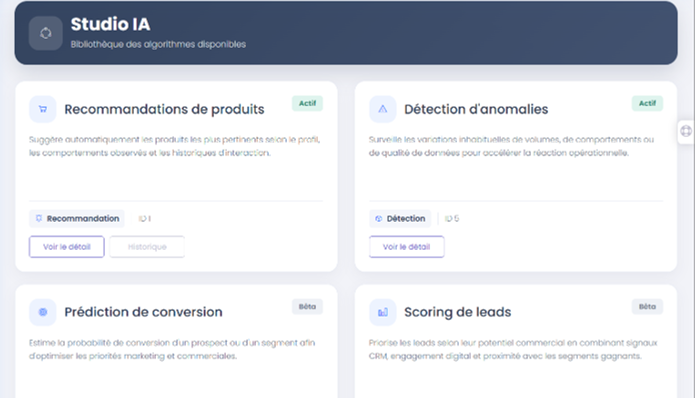
When the data is clean, structured, and sufficiently rich, it can also feed models. of artificial intelligence.
The AI can then intervene in several use cases:
- predicting a probability of purchase;
- identify the contacts most likely to convert;
- detecting a risk of inactivity or churn;
- recommend the most relevant product;
- personalizing an offer or content;
- Prioritize the hearings to be activated.
Let's take a concrete example.
A food supplement sales site can use its CDP to cross-reference multiple data sources: product catalog, purchase history, browsing behavior, reviews, external data, or engagement signals. By adding an AI layer, it becomes possible to identify customers or prospects with a high probability of purchase within the next 15 or 30 days.
But this is only a first step. The next question is equally important: which product should we recommend to them?
Thanks to a recommendation engine, CDP can analyze purchase history, products viewed, similar behaviors of other contacts, and navigation context to propose the most relevant offer.
We then move from manual customization, often limited to a few scenarios, to customizable customization that can be industrialized.
From “one to few” to “one to one” industrialised
For a long time, marketing personalization relied on conditional rules: if the customer bought such a product, then recommend them another product; if they belong to a certain segment, then send them a certain message; if they clicked on a certain email, then trigger a certain scenario.
These rules remain useful, but they quickly become difficult to maintain as the volumes of data, products, channels, and journeys increase.
A CDP enriched by AI allows us to go further.
It can take into account a contact, but also their context: their recent behavior, their history, their preferred channel, their level of engagement, their likely profile, their real-time navigation, or even the signals derived from the’analytics.
The engine no longer simply applies a fixed rule. It calculates the best possible recommendation based on the available data.
This makes the “one to one” approach much more accessible, without requiring marketing teams to create hundreds of manual conditions.
Beware of the “garbage in, garbage out” principle”
AI does not magically correct a low-quality data set.
On the contrary, the more companies rely on predictive models, recommendation engines, or intelligent agents, the more the quality of the data becomes strategic.
If the input data is incomplete, outdated, inconsistent, or poorly structured, the recommendations in the output may be of little relevance. This is the well-known principle of “garbage in, garbage out”.
In other words: an AI fed by bad data will rarely produce a good decision.
The CDP plays a foundational role here. It allows data to be prepared, cleaned, made reliable, and structured before being made available to activation tools, AI models, or scenario generators. marketing automation.
How to get started well?
To effectively transform customer data into a CDP, it is recommended to proceed in stages.
Start by identifying the data that is truly useful for your marketing use cases: SMS activation, email personalization, product recommendation, CRM segmentation, lead scoring, cart re-engagement, loyalty, or reporting.
Then, evaluate the quality of this data: are they complete? up-to-date? standardized? deduplicated? usable across channels?
Then define the necessary transformations: creation of age groups, grouping of products, calculation of scores, construction of segments, enrichment of profiles, or rapprochement of identities.
Finally, relate these transformations to concrete use cases. A data set should not be transformed “to make it cleaner,” but to make decisions better, target it better, and activate it better.
Things to remember
A CDP is not limited to centralizing customer data. Its value also lies in its ability to make it reliable, understandable, and actionable.
Cleaning, normalization, deduplication, enrichment, segmentation, scoring, profiling, recommendation: all these steps allow transforming raw data into customer knowledge.
For marketing directors, CMOs and CRM managers, the stakes are high: better understanding audiences, prioritizing actions, personalizing messages and improving campaign performance.
In the age of AI marketing and automation, this step becomes even more critical. Before attempting to predict, recommend, or personalize on a large scale, it is necessary to ensure that the data used is clean, reliable, and usable.
With Smartprofile, companies have a French platform combining CDP, Web & Mobile Analytics, marketing automation and AI to collect, unify, transform and activate their data. customer data in a controlled, compliant and performance-oriented environment.
Do you want to turn your customer data into marketing activation levers? Exchange with our teams to identify the priority use cases to implement with your CDP.