
What is it about?
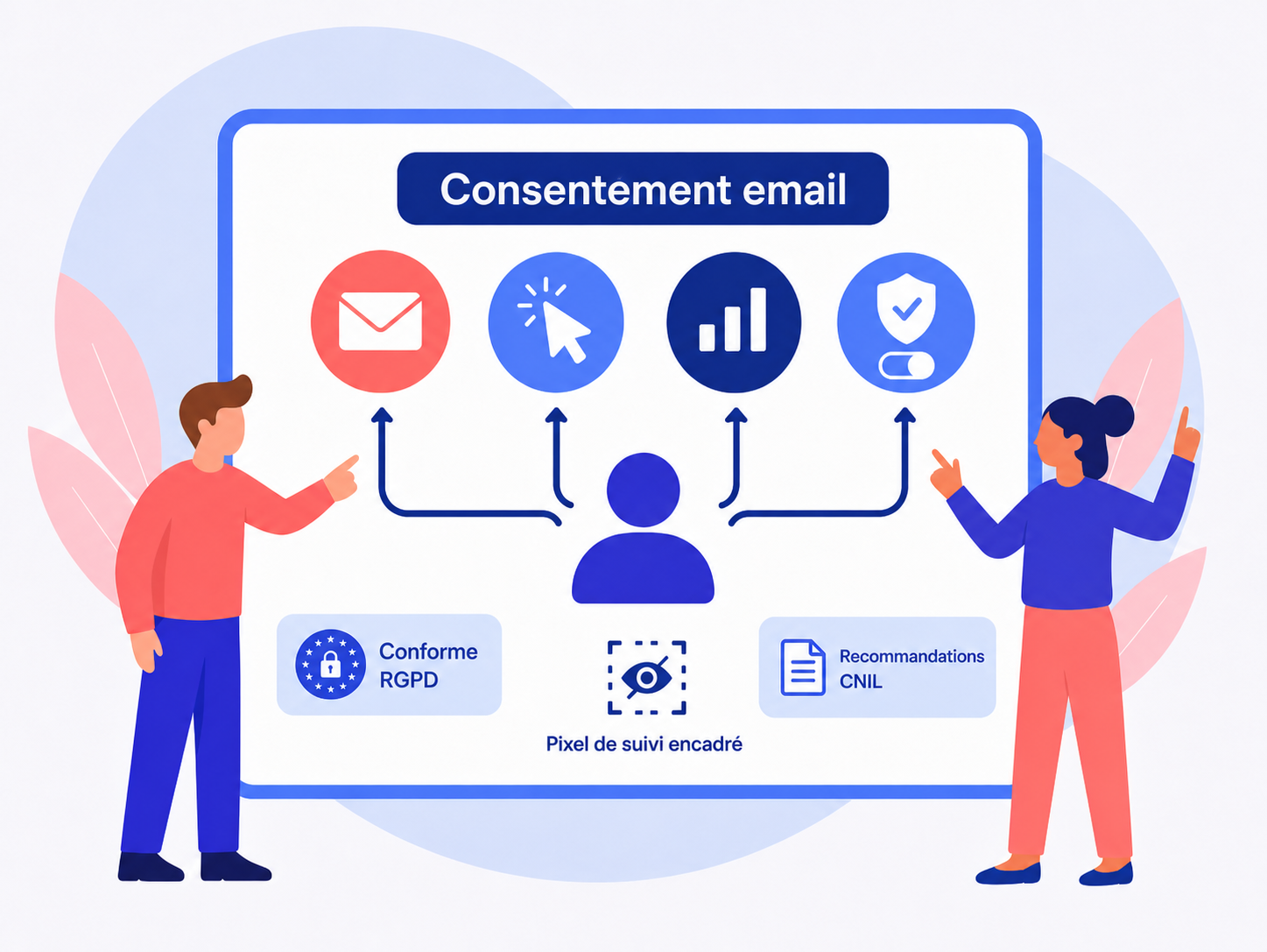
After several revisions, the CNIL published on April 14, 2026, the final version of its recommendation regarding tracking pixels in electronic mail (emails).
This recommendation aims to provide clarification for all stakeholders in email marketing regarding the use of trackers to track the behavior of a contact following the receipt of an email, such as opening or clicking.
The CNIL thus wishes to better regulate the tracking carried out by the various actors involved in email marketing when sending a campaign through this channel.
From now on, Dedicated and specific consent is necessary for the processing corresponding to the monitoring of a contact’s behavior following the receipt of an email (opens, clicks, etc.). Thus, the sender of an email and its subcontractors must ensure that the corresponding consent to the use of a tracking pixel in an email has been previously obtained.
Why this recommendation?
Although this publication is new, the legal bases are not: in fact, these recommendations provide additional information on Article 82 of the Data Protection Act, which regulates, among other things, the use of cookies and other trackers on websites, mobile applications, and online services.
Although this article is now integrated by advertisers through the implementation of cookie banners, the CNIL wanted to provide clarification for email senders. Indeed, tracking the behavior of Internet users via the tracking pixel in an email is ultimately just an extension of this text dedicated to supporting emails.
This recommendation provides a number of clarifications and thus provides a clear framework for the various players in email marketing, whether the email senders, the distribution tool, or any providers that may use a tracking pixel in an email.
These clarifications include the following points:
- Email senders (advertisers) will be able to continue to track the behavior of contacts whose email addresses were collected before April 2026. For these specific contacts, for whom an opt-in had already been collected for the sending of emails, clear information must be provided in a 3-month deadline to inform them of the specific processing carried out to monitor their behavior (via the tracking pixel) while giving them the opportunity to object to it.
- For new contacts: free, specific, informed and unanimous consent must be obtained, ideally from the very moment the address is collected.
- A mechanism for withdrawing consent must be proposed when sending emails to allow for the differentiated management of this consent in particular.
- The historicization of consent and its proof will also be necessary.
- In some cases, an exemption scheme may apply, so that it will be possible to collect the last opening date of an email for a contact without linking it to a specific campaign, in order to manage deliverability issues.
NB: One Exemption regime It is therefore proposed to address the purposes of securing authentication or deliverability (the regime enjoyed by the original text on cookies and other trackers for monitoring the traffic of websites).
Who is affected?
All organizations that conduct email campaigns and track the opens and clicks of their contacts individually, regardless of the purpose (performance analysis, delivery optimization, scoring, etc.)
Whether communicating with individuals, professionals, or employees, all broadcasters must ensure that from April 14, 2026, consent to track emails has been obtained.
Specifically, what are the repercussions?
You will now need to distinguish within your database the contacts for whom you have consent to track your campaigns from those for whom you do not have such consent.
Thus, monitoring the behavior of contacts will no longer always be possible, with the following consequences:
- Less visibility on the individual openings
- One less detailed reporting email at the contact level
- Disappear less complete marketing scores when they rely on openings or interactions
- Disappear marketing automation scenarios to review when they use opening or clicking as a condition
- One better traceability to be put in place around consent, its proof and withdrawal
How do I get compliant?
To be compliant, an action plan must be put in place with your various providers:
- Frame the monitoring objectivesDistinguish the uses performed in the context of tracking openings and behaviors (performance measurement, personalization, targeting, scoring)
- Update the information provided to contactsYour information mentions, your privacy policy, and, if necessary, your information regarding trackers must clearly explain the use of tracking pixels: data collected, purposes, relevant actors, and options for choice.
- Adapting the collection formsFor new contacts, consent to marketing follow-up must be provided at the time of collecting the email address when the use of the email address requires it. It must remain separate from consent to receive communications: a contact can accept your emails without agreeing to be individually tracked.
- Inform the contacts already present in the baseFor existing contacts, clear information must be sent to explain the use of tracking pixels and the associated purposes. The recipient must be able to easily object to tracking for future mailings. This information, ideally via a dedicated email, must be provided. within 3 months of the recommendation, either before July 14, 2026.
- Updating the email tool and the preferences centerConsent must be linked to contact, its withdrawal must be managed simply, and it must be avoided that a refusal to follow up automatically leads to the deactivation of all communications.
- Adapting the scenarios of marketing automation Scenarios that use openings, clicks or other interactions will need to be reviewed. Contacts without consent to marketing follow-up should be excluded from these logics or redirected to alternative paths.
- Keep the proof of consentCompliance also relies on the ability to demonstrate the consent obtained: date, source, accepted purpose, version of the information presented and any possible withdrawals.
In all cases, we strongly recommend that you have a DPO assist you in validating the formulations of the purposes and any information to be communicated to your contacts.
What needs to be remembered
The CNIL does not prohibit tracking pixels in emails, but it specifies the conditions for their use. When they are used to measure performance, customize messages, target contacts, or feed an individual scoring system with an example, specific consent is now required. Existing contacts must be informed, registration forms must incorporate this consent, and the implementation of a withdrawal of consent is necessary. Do not forget to inform your existing contacts within 3 months from April 14, 2026!
Would you like to discuss this new consent with our teams? The Smartprofile solution is ready and our teams are familiar with its proper use: Contact us !